TRADE UPDATE
Food & Agriculture
December 23, 2025
By Kristy Goodfellow, Vice President of Trade and Industry Affairs, and Ameya Khanapurkar, Project and Policy Coordinator

HIGHLIGHTS
- USTR:
- U.S. Trade Representative (USTR) Jamieson Greer formally briefed the House Ways and Means Committee and the Senate Finance Committee regarding the U.S.-Mexico-Canada Agreement, summarizing prominent agriculture trade concerns and outlining the agreement’s successes and shortcomings
- Several U.S. food and agricultural organizations argued that China has not complied with the U.S.-China Phase I Agreement during the Section 301 investigation hearing last week.
- Julie Callahan was confirmed by the Senate to the position of USTR Chief Agricultural Negotiator, with a 53-43 vote along party lines.
- WTO:
- The U.S. called into question the Most Favored Nations principle in a paper outlining the U.S. concerns ahead of the WTO’s 14th Ministerial Conference (MC14).
- US-Mexico:
- Mexico initiated a countervailing duty investigation into imports of U.S. pork legs and shoulders.
- European Union:
- The European Union (EU) has delayed the signing of a potential trade deal with Mercosur countries amid backlash from farmers in France, Italy, and Poland.
“The issue with the World Trade Organization is that it doesn’t — and probably can’t — deal with nontariff barriers, such as labor laws, currency manipulation, banking laws, and environmental regulations, or lack thereof. These barriers are a reflection of how you organize your society. China and some other countries are organized in a way that will always produce a trade surplus. In past WTO negotiations on tariffs, when we got the Tokyo and Uruguay rounds, we tried to get into nontariff barriers. But I think it was a mistake to think you could negotiate them, because countries can come up with new ones the minute you’ve resolved an old one.”
—Former USTR Robert Lighthizer via an interview with McKinsey
USTR
USTR REPORT TO CONGRESS ON USMCA
- U.S. Trade Representative (USTR) Jamieson Greer formally briefed the House Ways and Means Committee on Dec. 16 and the Senate Finance Committee on Dec. 17, delivering what Greer says fulfills USTR’s requirement for a report to Congress 180 days prior to the July 1, 2026, deadline for a joint review. Greer asserted that the “statute [of the U.S.-Mexico-Canada Agreement (USMCA) Implementation Act] does not require” a written report.
- Greer summarized prominent agriculture trade concerns, including dairy market access in Canada, imports of seasonal produce from Mexico, mandatory country-of-origin labeling for beef, maintaining a duty-free environment, and strong provisions to help ensure science-based sanitary and phytosanitary measures.
- Greer offered that USMCA successes are demonstrated by stakeholders’ broad support for the agreement, the resulting certainty for North American trade, and the increase in Mexican wages.
- Greer categorized the agreement’s shortcomings as either specific or structural issues. The specific issues he noted included Mexico’s labor law enforcement and unfavorable changes within the business climates in Mexico and Canada. The structural issues included the persistent U.S. trade deficit in goods and the agreement’s inability to address the surge of investment and the effects of industrial overcapacity.
- However, Greer acknowledged that Mexico and Canada have expressed interest in action toward economic security issues, underscoring the proposal approved by the Mexican Senate to apply tariffs to 1,400 products from non-FTA partners to combat nonmarket overcapacity.
CHINA SECTION 301 PHASE I COMPLIANCE HEARING
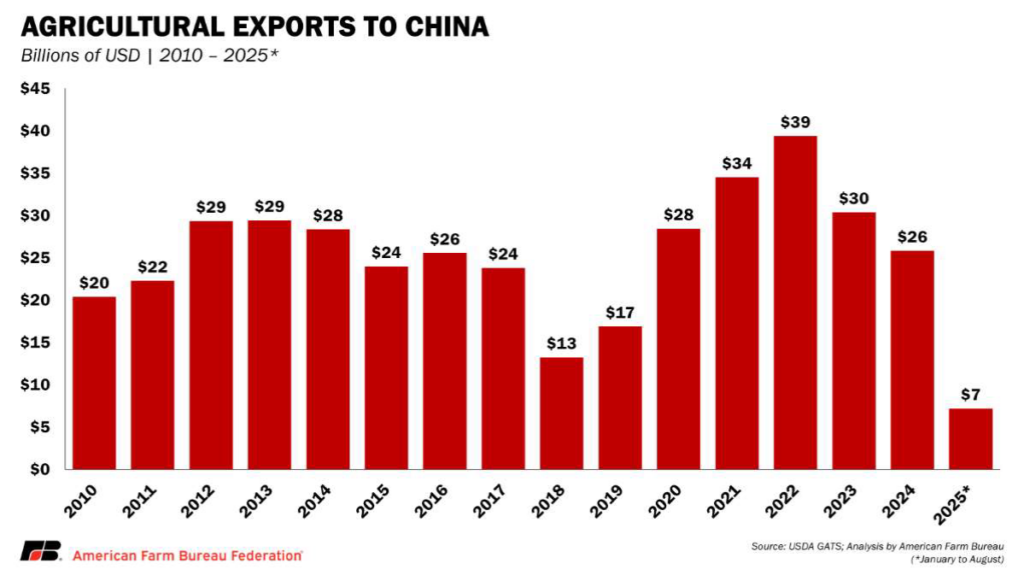
- On Dec. 16, the Section 301 Committee convened a public hearing as part of an ongoing Section 301 investigation examining whether China has implemented its commitments under the Phase I Agreement, which was signed in 2020.
- Several U.S. food and agricultural contributors to the investigation described how China is not complying with Phase I obligations.
- The American Seed Trade Association (ASTA) argued China is in breach of almost all of the agricultural biotechnology provisions. ASTA’s public comments state “China’s biotechnology approval process remains one of the single highest barriers to entry in commercialization of U.S. agricultural biotechnology products, particularly for U.S. exports of corn, soy, canola, alfalfa, and potatoes.”
- The National Corn Growers Association, American Soybean Association, and U.S. Soybean Export Council echoed the comments about biotechnology and also noted China’s unmet obligation for commodity purchases.
- ASA and USSEC argued USTR should focus on China implementing its commitments and maintaining soy growers’ access to China’s markets rather than instituting new tariffs.
- Similarly, the American Farm Bureau Federation urged the administration to engage with Chinese counterparts to resolve trade concerns before resorting to further tariffs.
- The National Milk Producers Federation and U.S. Dairy Export Council encouraged the administration to “preserve and build on” the Phase I agreement. These groups noted China’s compliance with most of the dairy-related provisions.
USTR CHIEF AGRICULTURAL NEGOTIATOR CONFIRMED
- Dr. Julie Callahan was confirmed to the position of USTR Chief Agricultural Negotiator. Her nomination cleared the Senate in a package of almost 100 other nominees approved by a 53–43 party-line vote.
- Most recently, Callahan has been serving as Assistant USTR for Agricultural Affairs.
- Callahan has a PhD in Environmental, Earth and Ocean Science from UMass Boston and has worked most of her career in the federal government, including at USTR, USDA, and the Food and Drug Administration.
WTO
THE UNITED STATES ON WTO REFORM
- In the run-up to the World Trade Organization (WTO) 14th Ministerial Conference (MC14), which is scheduled for March 2026, the United States sent a communication to the WTO General Council responding to issues raised by the reform facilitator, outlining additional issues that the U.S. believes needs to be taken up as part of the reform agenda, and explaining concerns with systematic issues that the WTO has been unable to address.
- Perhaps most notably, the U.S. communication brings into the discussion the Most Favored Nation (MFN) principle — the requirement to treat all WTO members equally and without discrimination. The paper calls the principle unsuitable for this era and says the expectation that this would deepen convergence among trading partners was “naïve.”
- The communication identifies several systemic problems that the WTO cannot address, including persistent trade imbalances, industrial overcapacity, economic security, and supply chain resilience.
- The document pushed for plurilateral negotiation paths and is skeptical that additional multilateral consensus is achievable. Notably, it asserts that if the WTO does not develop mechanisms to negotiate plurilateral agreements, trade negotiations will happen outside of the WTO.
US-Mexico
PORK COUNTERVAILING DUTY INVESTIGATION
- Mexico initiated a countervailing duty investigation into imports of pork legs and shoulders from the United States.
- The investigation, initiated on Dec. 15, will assess whether foreign producers are receiving unfair government subsidies and whether those subsidies are causing or threatening to cause injury to the Mexican industry.
- The preliminary determination is due on March 15, 2026, and a final determination is due Sept. 1, 2026.
- The U.S. exported $2.6 billion in pork and pork products to Mexico in 2024, most of which is within the scope of the investigation.
European Union
EU – MERCOSUR DEAL POSTPONED
- The European Union (EU) has delayed the signing of a potential trade deal with Mercosur countries amid backlash from farmers in France, Italy, and Poland.
- Farmers have raised concerns regarding the more relaxed environmental and agricultural standards of some South American countries, which they worry will lead to cheap agricultural imports.
- This development comes after the European Council and Parliament agreed on rules to safeguard the EU agri-food sector. The regulation allows the EU to temporarily suspend tariff preferences on agricultural imports from Mercosur if they harm EU producers. For “sensitive products,” investigations can be undertaken in response to an 8% price undercut coupled with either an 8% increase in preferential import volumes or an 8% drop in import prices.
We have reached out to our Mercosur partners and agreed to postpone slightly the signature.
— Ursula von der Leyen (@vonderleyen) December 19, 2025
This deal is crucially important for Europe – economically, diplomatically, and geopolitically.
It opens new trade and economic opportunities for all our Member States.
With… pic.twitter.com/wqNesX4giH