TRADE UPDATE
Food & Agriculture
December 16, 2025
By Kristy Goodfellow, Vice President of Trade and Industry Affairs, Ameya Khanapurkar, Project and Policy Coordinator, and Jacob Slattery, CRA Intern
HIGHLIGHTS
- USTR:
- During a hearing on Capitol Hill, U.S. Trade Representative Jamieson Greer urged the Senate Appropriations Subcommittee to increase USTR funding by $21 million for FY2026, discussed the Trump Administration’s trade agenda objectives, and summarized some key trade actions throughout the year.
- Separately, Greer reflected on the first year of what he calls a “new global trading system” during an Atlantic Council Front Page event.
- Tariffs:
- The U.S. will phase in tariffs on imported Nicaraguan non-originating goods in response to a Section 301 investigation into Nicaragua’s abuse of labor rights, human rights and freedoms, and the dismantling of the rule of law.
- Congress:
- The House Ways and Means Committee approved a bill to extend the African Growth and Opportunity Act (AGOA), an expired trade preference program offering certain products duty-free access to the U.S. market for eligible Sub-Saharan African countries.
- Trade Data:
- North Dakota State University’s December Agricultural Trade Monitor charts potential Supreme Court rulings on the Trump Administration’s use of the International Emergency Economic Powers Act for its tariff agenda, the effect of exemptions on the effective tariff rate on agriculture inputs, food import tariffs, a summary of recent trade deals, and China’s soybean purchases.
“People in Washington like to talk about China hawks and China doves. That’s a distinction that doesn’t really resonate with the Trump Administration because we’re just pro-American. We’re not anti-anybody, we’re pro-American, America First.”
—U.S. Trade Representative Jamieson Greer during Atlantic Council Front Page event
USTR
GREER TESTIFIES BEFORE SENATE SUBCOMMITTEE
- On Dec. 9, U.S. Trade Representative (USTR) Jamieson Greer urged a Senate Appropriations Subcommittee to increase USTR funding by $21 million for FY2026, arguing that expanded staffing is essential to enforce agreements, negotiate new deals, and manage a dramatically expanded workload under the administration’s trade agenda.
- During the hearing, Greer defended the administration’s reciprocal tariff strategy, emphasizing its role in responding to the $1.2 trillion goods trade deficit and restoring U.S. manufacturing capacity.
- Greer highlighted a wave of reciprocal trade deals and framework agreements negotiated over the summer and fall.
- Greer responded to many questions related to consumer costs, business uncertainty, and lost export markets.
GREER ON NEW GLOBAL TRADE SYSTEM
- Greer used comments at an Atlantic Council Front Page event to reflect on the first year of what he calls a “new global trading system.”
- Greer emphasized the Trump Administration’s tariff-driven strategy to rebalance trade, revive manufacturing, and prioritize national economic security.
- Greer outlined the administration’s “report card” metrics: a declining bilateral trade deficit with China, rising blue-collar wages, and strong indicators of U.S. reindustrialization such as record capital-goods shipments and increased private investment. He acknowledged the lag in manufacturing employment, which he attributed, in part, to changes in the U.S. labor force.
- Responding to questions about global alignment and China, Greer reaffirmed that the administration seeks a “managed, more balanced” U.S.-China trade relationship, not full decoupling of the two countries. He said this can be pursued while maintaining leverage through high tariffs, reciprocal agreements, and tools such as Section 232 and Section 301 to counter overcapacity, unfair regulations, and supply-chain vulnerabilities.
Tariffs
SECTION 301 ACTION ON NICARAGUA
- The U.S. will phase in tariffs on imported Nicaraguan goods that do not originate under the Dominican Republic-Central America-United States Free Trade Agreement (CAFTA-DR) in response to a Section 301 investigation into Nicaragua’s abuse of labor rights, human rights and freedoms, and the dismantling of the rule of law.
- The phased-in tariff will apply starting Jan. 1, 2026, at 0% and increase to 10% on Jan. 1, 2027. A final increase to 15% will occur on Jan. 1, 2028.
- These new tariffs will be layered on top of the existing U.S. 18% “Reciprocal Tariff” applied to Nicaraguan imports.
- Most of Nicaragua’s agricultural exports to the U.S. are expected to meet the origin requirements of CAFTA-DR and therefore be exempt.
Congress
WAYS AND MEANS APPROVES AFRICAN TRADE PROGRAM RENEWAL
- On Dec. 10, the House Ways and Means Committee approved a bill to extend the African Growth and Opportunity Act (AGOA), a lapsed trade preference program offering some products duty-free access to the U.S. market for eligible Sub-Saharan African countries.
- The draft bill extends AGOA for three years, or until Dec. 31, 2028.
- During his Senate hearing, Greer indicated the Trump Administration is open to a one-year extension of AGOA.
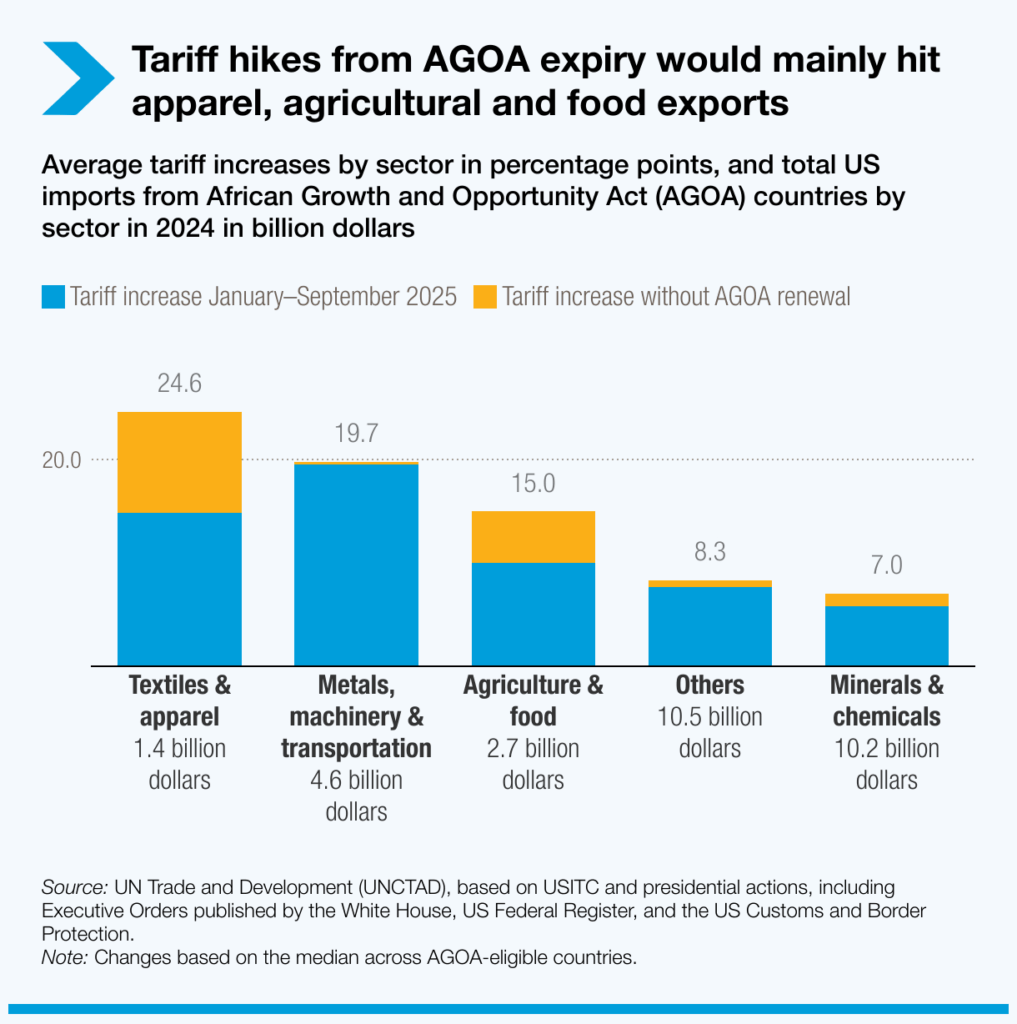
- In October, the United Nations Committee on Trade and Development published an analysis of AGOA’s expiration. The publication notes “the expiry of AGOA would disproportionately affect Africa’s light-manufacturing exports to the U.S., namely apparel and agro-food products, such as fish and dried fruit.”
Trade Data
NDSU AGRICULTURAL TRADE MONITOR
- The December Agricultural Trade Monitor from North Dakota State University’s Center for Agricultural Policy and Trade Studies charts potential Supreme Court rulings on the Trump Administration’s use of the International Emergency Economic Powers Act for its tariff agenda; the effect of exemptions on the effective tariff rate on agriculture inputs; food import tariffs; a summary of recent trade deals; and China’s soybean purchases.
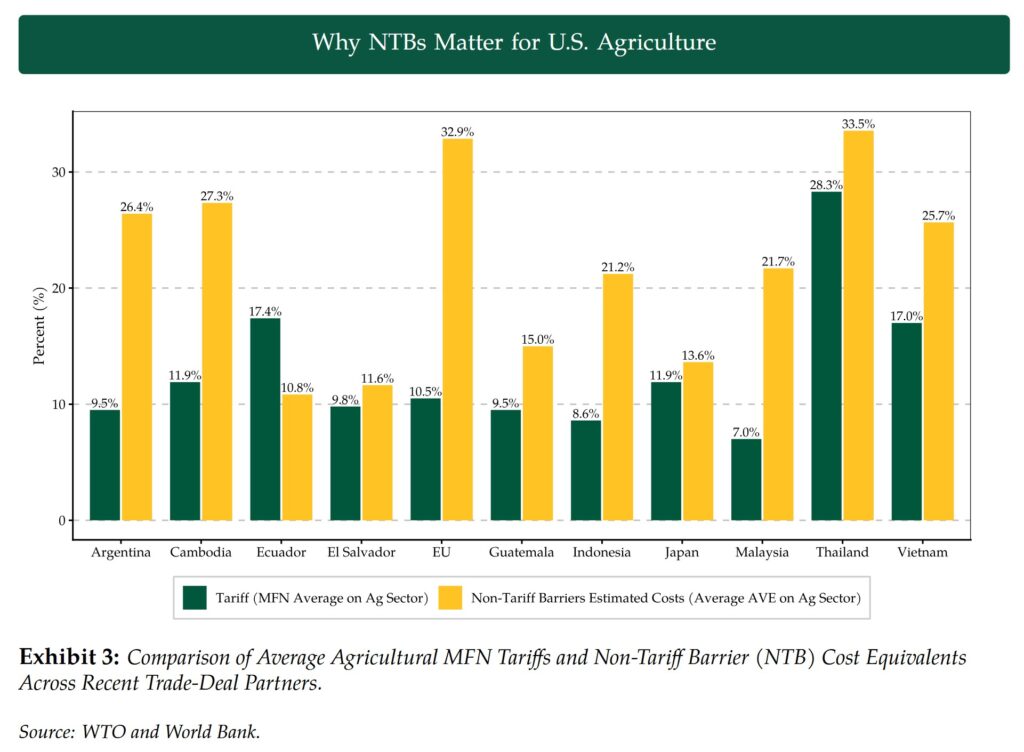
- In addition to summarizing the status of reciprocal tariffs, the report emphasizes that non-tariff barriers represent a higher estimated cost to U.S. agriculture exports in most of the countries with which the United States is currently negotiating.
- The report notes that in November, the Trump Administration announced reductions of tariffs and exemptions for a broad set of agriculture inputs and food products. Fertilizers saw the largest cuts amongst inputs. Beef, coffee, and fresh fruits and vegetables saw the largest cuts among food items.
- While China usually buys U.S. soybeans when they are cost-competitive relative to Brazil, the country recorded daily flash purchases of U.S. soybeans in November, even when at higher prices than Brazilian beans. The report suggests that this could mean that the trade commitments of the U.S.-China agreement override regular price-driven purchasing patterns.