TRADE UPDATE
Food & Agriculture
November 25, 2025
By Kristy Goodfellow, Vice President of Trade and Industry Affairs, Ameya Khanapurkar, Project and Policy Coordinator, and Jacob Slattery, CRA Intern
HIGHLIGHTS
- Tariffs and Bilateral:
- On Nov. 20, the White House announced exclusions from 40% tariffs for certain agricultural products from Brazil, including beef and beef products, coffee, tropical fruit, nuts, and spices.
- Trade Promotion:
- USDA Undersecretary for Trade and Foreign Agricultural Affairs Luke Lindberg traveled to the European Union to help implement the U.S.-European Union Trade Framework deal signed in August.
- USDA’s Foreign Agricultural Service announced $285 million available in grants for the 2026 America First Trade Promotion Program.
- Supply Chains:
- The U.S.-China Economic and Security Review Commission released its 2025 Annual Report to Congress. This publication details several arenas of strategic competition, including China’s overcapacity-driven export surge, and recommends that the U.S. build a resilient bioeconomy industry base.
- USTR:
- The Senate Finance Committee advanced Julie Callahan’s nomination to serve as the Chief Agricultural Negotiator at the Office of the U.S. Trade Representative (USTR).
- Trade Data:
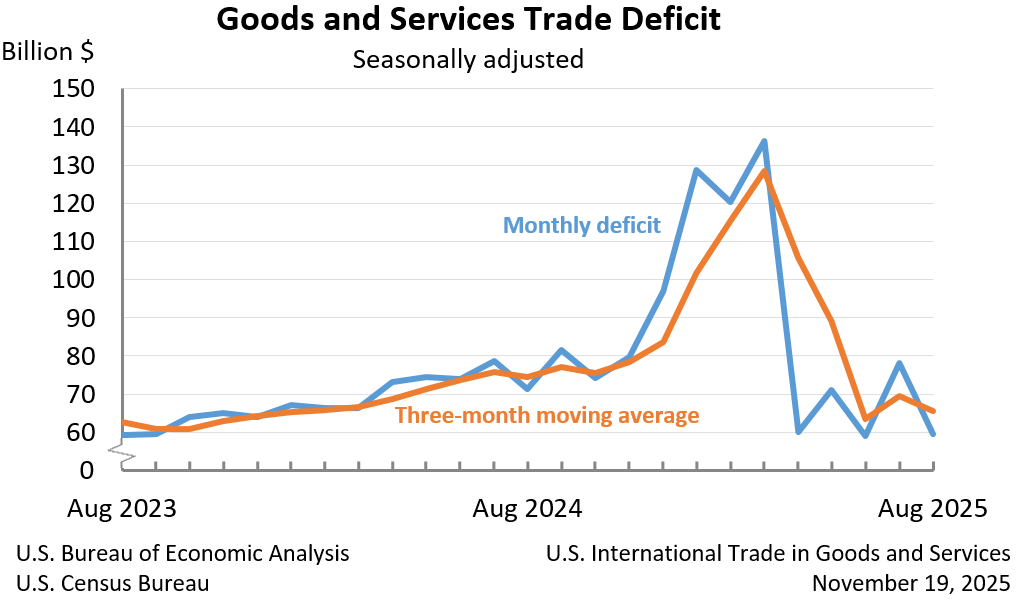
- The U.S. goods and services trade deficit fell to $59.6 billion in August 2025 – down from $78.2 billion in July – reflecting a 5.1% drop in imports and a 0.1% rise in exports.
- WTO:
- The World Trade Organization’s Fish Fund Steering Committee approved 26 requests for grants aimed at helping developing and least-developed countries implement the WTO Agreement on Fisheries Subsidies.
“China relies on the rest of the world to absorb the excess production caused by its over-investment and is on track to set a new record trade surplus of over $1 trillion in 2025, breaking its own record set just last year. This massive outpouring of exports, which we call ‘China Shock 2.0,’ threatens both advanced and developing economies.”
—Reva Price, Chair of the U.S.-China Economic and Security Review Commission
Tariffs and Bilateral
MODIFIED AGRICULTURAL TARIFFS FOR BRAZIL
- On Nov. 20, the White House announced exclusions from tariffs for certain agricultural products from Brazil, including beef and beef products, coffee, tropical fruit, nuts, and spices.
- These products are now exempt from the 40% tariffs that were added on July 30, effective Nov. 13, but do not apply to the 10% reciprocal tariff.
- A Section 301 investigation is underway into Brazil’s Acts, Policies, and Practices Related to Digital Trade and Electronic Payment Services; Unfair, Preferential Tariffs; Anti-Corruption Enforcement; Intellectual Property Protection; Ethanol Market Access; and Illegal Deforestation.
- In 2024, the United States imported $9.9 billion in agricultural and related products from Brazil, including $2 billion in unroasted coffee; $1.5 billion in forest products; $1.4 billion in beef, and $1.4 billion in fruit and vegetable juices.
Trade Promotion
USDA T.R.U.M.P. MISSION TO THE EUROPEAN UNION
- USDA Undersecretary for Trade and Foreign Agricultural Affairs Luke Lindberg traveled to the European Union (EU) to help implement the U.S.-EU Trade Framework deal signed in August.
- The meetings featured agribusiness representatives and addressed the EU regulatory horizon, including ensuring deforestation rules do not act as a barrier to U.S. producers.
Under Secretary Luke J. Lindberg is leading @USDA THIRD TRUMP Mission in Brussels. The USA delegation includes 11 #ag cooperators who are working on sales under @POTUS new trade agreement. Last year we had a $23.6B ag trade deficit with the E.U. and it is time for reciprocity! pic.twitter.com/Kj44xFMG3D
— Foreign Ag Service (@USDAForeignAg) November 19, 2025
2026 AMERICA FIRST TRADE PROMOTION FUNDING ANNOUNCED
- USDA’s Foreign Agricultural Service announced $285 million available in grants for the 2026 America First Trade Promotion Program.
- Applicants are “encouraged to use this opportunity to propose new and innovative activities in non-traditional markets to generate increased export sales for U.S. farmers, ranchers, and producers.”
- The deadline for applications is Jan. 23, 2026.
Supply Chains
US-CHINA ECONOMIC AND SECURITY REVIEW COMMISSION
- The U.S.-China Economic and Security Review Commission released its 2025 Annual Report to Congress, which includes 28 recommendations aimed at managing the national and economic security implications of the bilateral relationship.
- The report highlights China’s overcapacity-driven export surge, including in agricultural products and inputs, which has disrupted industries in developed and developing countries.
- The report documents how overcapacity has afforded China leverage over critical inputs and supply chains and warns of China’s willingness to weaponize the supply chain chokepoints by highlighting their increasing use of export controls.
- The commission recommends that Congress work, as a strategic national objective, to build a resilient bioeconomy industry base. As part of the recommendation, the Commission proposed strengthening and expanding the USDA BioPreferred Program and establishing federal procurement commitments of biobased products.
- The report notes a sharp rise in global trade investigations, including antidumping duties, against China, with 160 cases initiated by 28 countries in 2024, up from 69 in 2023. The report suggests that the U.S. coordinate trade remedy actions with allies to combat dumping in third markets.
USTR
CHIEF AGRICULTURAL NEGOTIATOR
- The Senate Finance Committee advanced Julie Callahan’s nomination to serve as the Chief Agricultural Negotiator at the Office of the U.S. Trade Representative with a 17–10 vote.
- A full Senate confirmation vote with a simple majority will be needed for confirmation.
- Callahan’s nomination has received strong backing, with more than 80 agricultural trade associations supporting her due to her expertise in representing farmers, ranchers, and food producers in international markets.
Trade Data
U.S. INTERNATIONAL TRADE IN GOODS AND SERVICES, AUGUST 2025
- A new report from the Bureau of Economic Analysis and U.S. Census Bureau shows the trade deficit shrank earlier this year.
- According to the report, U.S. International Trade in Goods and Services, August 2025, the U.S. goods and services trade deficit fell to $59.6 billion in August 2025 – down from $78.2 billion in July – reflecting a 5.1% drop in imports and a 0.1% rise in exports.
- The goods deficit fell by about $18.1 billion, while the services surplus grew by about $0.5 billion.
- Despite the August result, the year-to-date trade deficit remains 25% higher than during the same period last year.
- In August, the Outlook for U.S. Agricultural Trade from USDA’s Economic Research Service revised its forecast of the 2025 Agriculture Trade deficit to $47 billion, down from its May projection of $49.5 billion. In 2024, the agricultural trade deficit was $32 billion.
WTO
WTO FISH FUND STEERING COMMITTEE
- The World Trade Organization’s Fish Fund Steering Committee approved 26 requests for grants aimed at helping developing and least-developed countries implement the WTO Agreement on Fisheries Subsidies. The grants totaled $2.9 million.
- The committee also agreed to launch a second call for funding requests in early 2026.
- The Steering Committee of the Fish Fund is made up of 16 WTO members representing contributors to and beneficiaries of the Fund: Australia, Barbados, Canada, France, The Gambia, Germany, Haiti, Iceland, Japan, Mauritius, the Netherlands, Peru, the Philippines, Seychelles, Sierra Leone, and Spain.
- The WTO Agreement on Fisheries Subsidies entered into force on Sept. 15, 2025.