TRADE UPDATE
Food & Agriculture
November 11, 2025
By Kristy Goodfellow, Vice President of Trade and Industry Affairs, Ameya Khanapurkar, Project and Policy Coordinator, and Jacob Slattery, CRA Intern
HIGHLIGHTS
- Tariffs and Bilateral Negotiations:
- The U.S. Supreme Court held a hearing to determine whether President Donald Trump legally invoked the 1977 International Emergency Economic Powers Act (IEEPA).
- Agriculture Inputs:
- The Department of the Interior added phosphate and potash — two agricultural fertilizers — to the Final 2025 List of Critical Minerals.
- Investigations:
- The Office of the U.S. Trade Representative (USTR) suspended responsive actions under the Section 301 investigation into China’s maritime, logistics, and shipbuilding sectors.
- Citing the high price of beef, President Trump called on the Department of Justice (DOJ) to begin an antitrust investigation into meatpacking companies. He argued that majority foreign-owned meat packers are responsible.
- USMCA:
- USTR has delayed hearings on the operations of the Agreement between the United States of America, the United Mexican States, and Canada (USMCA). Hearings were previously scheduled for Nov. 17 but moved to Dec. 3-5.
- Trade Data:
- The North Dakota State University Nov. Agricultural Trade Monitor report highlights implications of the new U.S.-China deal, including on soybean commitments and the port fee suspension, and deals with four Southeast Asian countries.
- The Purdue University/CME Group Agricultural Economy Barometer reported that U.S. farm sentiment edged up modestly in Oct. Farmer sentiment on tariff policy is mixed.
- U.S. Department of Agriculture (USDA):
- Despite the federal government shutdown, USDA facilitated an agribusiness trade mission to Mexico City led by U.S. Secretary of Agriculture, Brooke Rollins.
- Congress:
- Senator Susan Collins (R – ME) and Senator Elise Slotkin (D – MI) introduced the Fairness for Fruits and Vegetables Act aimed at addressing unfair trade practices against American specialty crop producers.
- On Nov. 6, six members of Congress sent a letter to U.S. Trade Representative Jamieson Greer requesting the delay in implementing the latest U.S.-EU trade deal.
- Farmers for Free Trade:
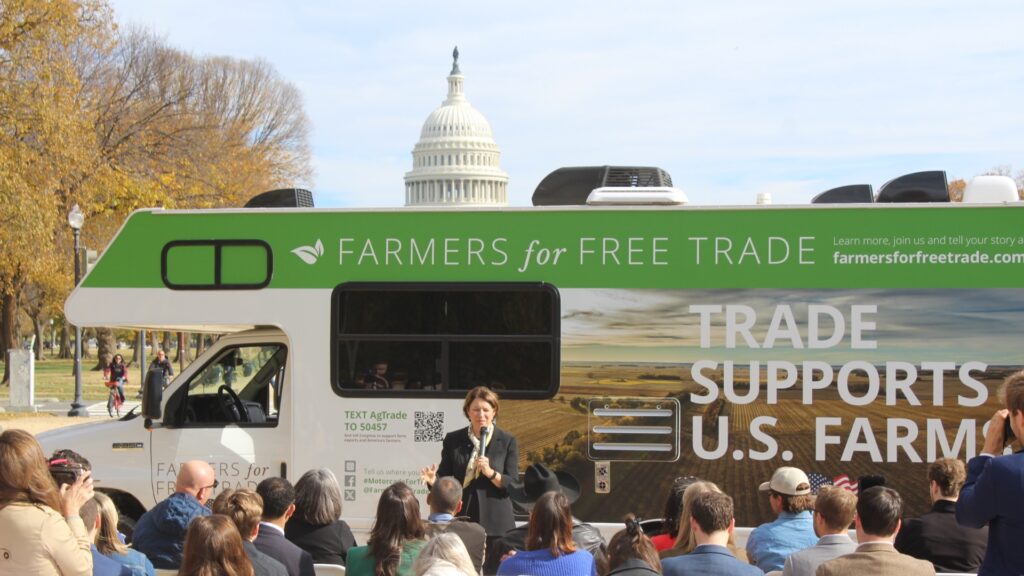
- Farmers for Free Trade concluded its 2,800-mile “Motorcade for Trade” tour in Washington, D.C., designed to amplify farmer voices who are calling for free market access.
“It’s one of the most important cases in the history of our country. … We made a wonderful deal for everyone—our farmers. As you know—soybeans at levels nobody has ever seen before. We were able to make phenomenal deals. If we didn’t have the tariffs, we wouldn’t be able to do this. … It would be devastating for our country, but I also think we will have to develop a game 2 plan.”
—President Trump in response to a question: What is your plan if [sic] the Supreme Court ends up making a decision that’s not in your favor?
Tariffs and Bilateral
LEARNING RESOURCES V. TRUMP
- The U.S. Supreme Court heard oral arguments regarding the legality of President Donald Trump’s tariff measures under the International Emergency Economic Powers Act (IEEPA). The consolidated cases challenge Trump’s claim that emergency powers allow the president to set tariffs.
- Justices questioned whether IEEPA could be used for tariff policy, and noted that Congress holds authority over tax policy. Furthermore, justices observed explicit language and clear safeguards in previous instances where Congress has delegated tariff authority to the executive.
- A final decision is expected in the coming months, considering requests from both sides to expedite the ruling.
- Trump disagreed with the premise that IEEPA allows the president to stop all trade with a foreign country but not place a tariff on a country.
- Trump also stated that the U.S. government would pay a $2,000 tariff dividend to everyone except “high-income people.”
Agriculture Inputs
AG FERTILIZERS ADDED TO 2025 CRITICAL MINERALS LIST
- The Department of the Interior added phosphate and potash — two agricultural fertilizers — to the Final 2025 List of Critical Minerals, which was announced on Friday.
- This list guides federal strategy, investment, and permitting decisions, per the U.S. Geological Survey.
- A draft list published in Aug. included potash, and phosphate was later included after multiple members of Congress called for its inclusion. Potash was on the 2018 list, but both were omitted from the 2022 update.
- The Fertilizer Institute commended the inclusion of both, citing supply chain vulnerabilities due to production being concentrated in a few countries. China and Russia account for over 53% of global phosphate production and 67% of potash production with Belarus. Furthermore, the U.S. imports 97% of its potash needs.
Investigations
USTR SUSPENDS SECTION 301 INVESTIGATION ON SHIPBUILDING
- The Office of the U.S. Trade Representative (USTR) suspended responsive actions under the Section 301 investigation into China’s maritime, logistics, and shipbuilding sectors.
- This follows a major trade and economic agreement between Presidents Trump and Xi Jinping announced on Nov. 1.
- While the suspension is in place, the U.S. will engage in negotiations with China to address the concerns raised in the investigation. USTR notes concurrent domestic efforts and consultations with allies will continue to support revitalization of the U.S. shipbuilding industry.
DOJ INVESTIGATION INTO MEAT PACKING
- Citing the high price of beef, President Trump called on the Department of Justice (DOJ) to begin an antitrust investigation into meat packing companies, alleging collusion and price manipulation. He argued that majority foreign-owned meat packers are responsible.
- Meat Institute President and CEO Julie Anna Potts responded by highlighting that beef packers have been operating at a loss due to high cattle prices which U.S. Department of Agriculture (USDA) data demonstrates.
- Ranchers Cattlemen Action Legal Fund United Stockgrowers of America (R-CALF USA) CEO Bill Bullard welcomed the investigation, citing a disconnect between cattle and beef prices.
- This action builds on earlier proposals to reduce beef prices, including a controversial suggestion to import Argentinian beef, which drew criticism from many Republican lawmakers and the National Cattlemen’s Beef Association.
USMCA
USTR USMCA REVIEW HEARINGS DELAYED
- USTR has delayed hearings on the operations of the Agreement between the United States of America, the United Mexican States, and Canada (USMCA). Hearings were previously scheduled for Nov. 17 but moved to Dec. 3-5 and will take place at the U.S. International Trade Commission.
- One-hundred and seventy-three requests were made to participate in the hearing, including many food and agriculture organizations.
- There were 1,515 comments provided in response to USTR’s request for public comments on the functioning of USMCA.
Trade Data
NORTH DAKOTA STATE UNIVERSITY AGRICULTURE TRADE MONITOR
- The North Dakota State University Center for Agricultural Policy and Trade Studies released its Nov. 2025 Agricultural Trade Monitor report which highlights implications of the new U.S.-China deal, including on soybean commitments and the port fee suspension, as well as deals with four Southeast Asian countries.
- Regarding the purchase commitments for soybeans announced by the Trump Administration, the report notes increased ag commodity prices and a higher soybean basis. However, the report also points out a lack of information around how the commitment will be monitored and enforced, and whether there will be “market conditions” flexibility, as was included in the Phase One agreement.
- The report highlighted previous estimates that the Section 301 port fees would have added $2.3 billion to shipping costs for U.S. agriculture; and notes the one-year delay in implementation announced last week.
- The report notes new export potential for U.S. agricultural exports through agreements announced with Thailand, Malaysia, Cambodia, and Vietnam.
LIVESTOCK FARMER SENTIMENT IN OCTOBER
- The Purdue University/CME Group Agricultural Economy Barometer reported that U.S. farmer sentiment edged up modestly in Oct. 2025, rising 3 points to 129.
- Disparities among producers remain apparent: livestock producers noted strong profitability (especially in beef), while crop producers continued to report weak margins. Meanwhile, the Short-Term Farmland Value Expectations Index rose 7 points to 113.
- Policy uncertainty also shapes farmer sentiment, with mixed views on the long-term effects of U.S. tariff policy. Fifty-eight percent of producers said they expect tariffs to strengthen the agricultural economy—up from Sept. but down from nearly 70% in Apr. and May.
- Meanwhile, 16% of producers expressed uncertainty about tariff impacts, double the share recorded in spring, underscoring rising unease even as around 70% still believe the U.S. is headed in the “right direction.”
USDA
MEXICO TRADE MISSION
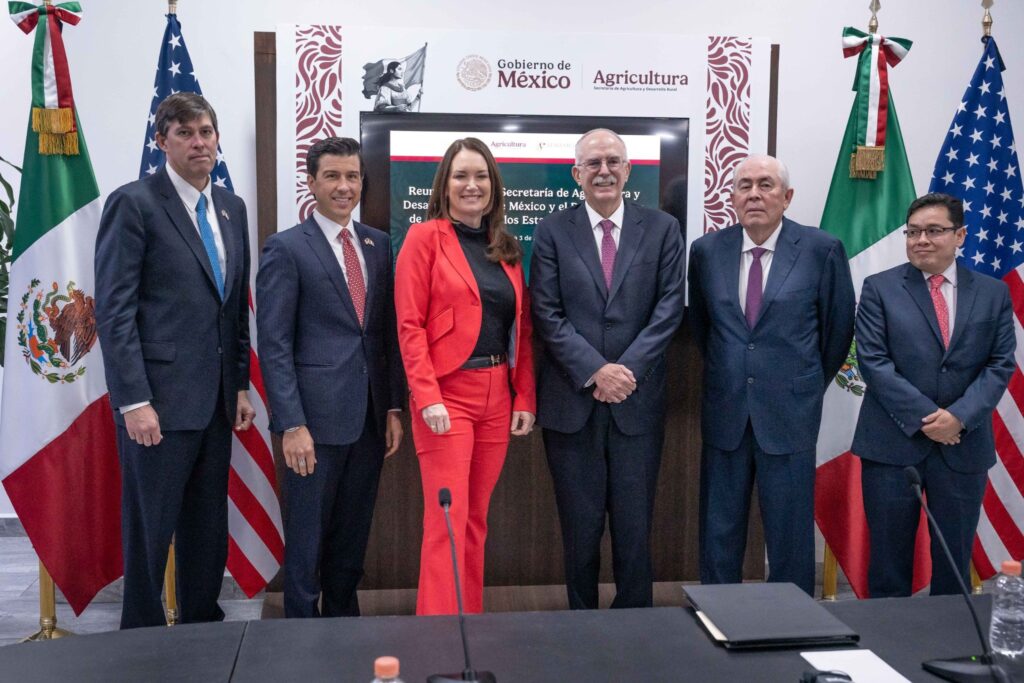
- Despite the federal government shutdown, USDA’s Foreign Agricultural Service facilitated an agribusiness trade mission to Mexico City, Mexico from Nov. 3-6, led by Secretary of Agriculture, Brooke Rollins.
- The mission aimed to connect U.S. producers with buyers in the Mexican market.
- Secretary Rollins, several senior officials from USDA, and industry participants met with government officials and business leaders in Mexico, including Secretary of Agriculture, Julio Berdegué, Secretary of Energy, Luz Elena González Escobar, and Ministry of Foreign Affairs.
- Agriculture Secretary Berdegué announced via X and a press release that the delegations reviewed progress on the New World Screwworm, prioritized resuming exports, and addressed issues around the agriculture trade agenda.
Congress
SPECIALTY CROPS
- Senator Susan Collins (R – ME) and Senator Elise Slotkin (D – MI) introduced the Fairness for Fruits and Vegetables Act aimed at addressing unfair trade practices against American specialty crop producers.
- This legislation would form a working group between USDA, USTR, the Department of Commerce, and other federal agencies to monitor data on these products and provide a platform for input from producers and trade associations on unfair trade practices.
- Senator Collins also called for USDA to provide disaster assistance to Maine’s specialty crop and livestock producers, citing extreme weather, high production costs, and labor shortages.
EUROPEAN UNION DEFORESTATION REGULATION
- On Nov. 6, six members of Congress sent a letter to USTR Jamieson Greer requesting the delay in implementing the latest U.S.-EU trade deal, arguing that despite European Commission statements, “the EU has made no significant reform of the regulation and is speeding up the timeline for implementation.”
- On Oct. 20, 2025, the European Commission proposed modifications to its EU Deforestation Regulation (EUDR), to address what the European Commission says will “ensure a smooth implementation of the EUDR”. The EC says the modifications will simplify reporting obligations, notably for micro and small primary operators for low-risk countries worldwide.
- The American Forest & Paper Association responded with a request for President Trump to hold the EU to its Aug. 21 commitments, stating this announcement was a “U-turn” from the EU Commission and arguing that it “does not meet the Commission’s commitment to avoid U.S.-EU trade disruptions.”
Farmers for Free Trade
MOTORCADE FOR TRADE
- On Nov. 4, Farmers for Free Trade concluded its 2,800-mile “Motorcade for Trade” tour in Washington, D.C.
- According to Farmers for Free Trade, the 14-state tour was “designed to amplify farmer voices calling for open markets and reduced trade barriers.”
- At the final stop of the “Motorcade for Trade” in Washington, D.C., Amy Klobuchar (D-MN) warned that the current tariff regime has made a difficult year disastrous for small farmers; “When these tariffs hit, it’s the small farms, it’s the small companies that are the immediate roadkill.”
- Indiana farmer Brent Bible emphasized that high and unpredictable tariffs, especially on imported farm-equipment parts and fertilizers, are increasing operating expenses in an already low-margin business.