TRADE UPDATE
Food & Agriculture
October 21, 2025
By Kristy Goodfellow, Vice President of Trade and Industry Affairs, Ameya Khanapurkar, Project and Policy Coordinator, and Jacob Slattery, CRA Intern
HIGHLIGHTS
- Tariffs and Bilateral Negotiations:
- U.S. Trade Representative Jamieson Greer and Secretary of State Marco Rubio met with Brazil’s Minister of Foreign Affairs Mauro Viera about trade and other bilateral issues.
- North Dakota State University’s Center for Agriculture Policy and Trade Studies highlighted China’s ability to avoid U.S. soy purchases in its Oct. 2025 report.
- Multilateral:
- The International Monetary Fund released its biannual World Economic Outlook report, analyzing the effects of the U.S. tariff surge and other factors on global economic and financial conditions.
- Trade Remedies:
- President Donald Trump is considering banning U.S. imports of used cooking oil (UCO) from China in retaliation for China’s steep drop in purchases of U.S. soybeans.
- Transportation:
- China’s Ministry of Transport announced retaliatory port fees on U.S. vessels docking in Chinese ports.
- The International Maritime Organization recently adjourned its efforts to cut all large ships’ emissions by 17% before 2028 and will resume discussions in 2026.
“Finally, work to strengthen the multilateral frameworks and institutions that have helped deliver considerable gains over the past decades must continue. If anything, an important reason for global resilience so far is also that most countries have exercised restraint in trade policy retaliation, have sought to forge better trade deals, and are still operating under well-established global trading norms.”
—Pierre-Olivier Gourinchas, economic counsellor and director of the Research Department at the International Monetary Fund, in the foreword of the World Economic Outlook, Oct. 2025
Tariffs and Bilateral Negotiations
US BILATERAL MEETING WITH BRAZIL
- U.S. Trade Representative Jamieson Greer and Secretary of State Marco Rubio met with Brazil’s Minister of Foreign Affairs Mauro Viera about trade and other bilateral issues.
- The officials agreed to continue discussions on multiple fronts and agreed to arrange a meeting between President Donald Trump and Brazilian President Lula da Silva.
- A Section 301 investigation is underway into Brazil’s Digital Trade and Electronic Payment Services; Unfair, Preferential Tariffs; Anti-Corruption Enforcement; Intellectual Property Protection; Ethanol Market Access; and Illegal Deforestation.
- In 2024, the United States exported $933 million in agricultural and related products to Brazil and imported $9.8 billion in agricultural and related products from Brazil, including $2 billion in unroasted coffee.
NORTH DAKOTA STATE UNIVERSITY OCTOBER 2025 REPORT
- North Dakota State University’s Center for Agricultural Policy and Trade Studies released its Oct. 2025 report, which highlights China’s ability to completely bypass purchasing U.S. soybeans and the impacts of International Emergency Economic Powers Act (IEEPA) tariffs on agriculture inputs.
- The report highlights China’s ability to fulfill 107 million metric tons (MMTs) of its projected 112 MMTs of soybean imports with purchases from Brazil and the rest of the world if it follows similar import reallocation patterns to the 2018-19 trade war.
- The report also indicates tariffs imposed under the IEEPA are driving diverging trends in U.S. agricultural input sourcing.
Multilateral
IMF WORLD ECONOMIC OUTLOOK
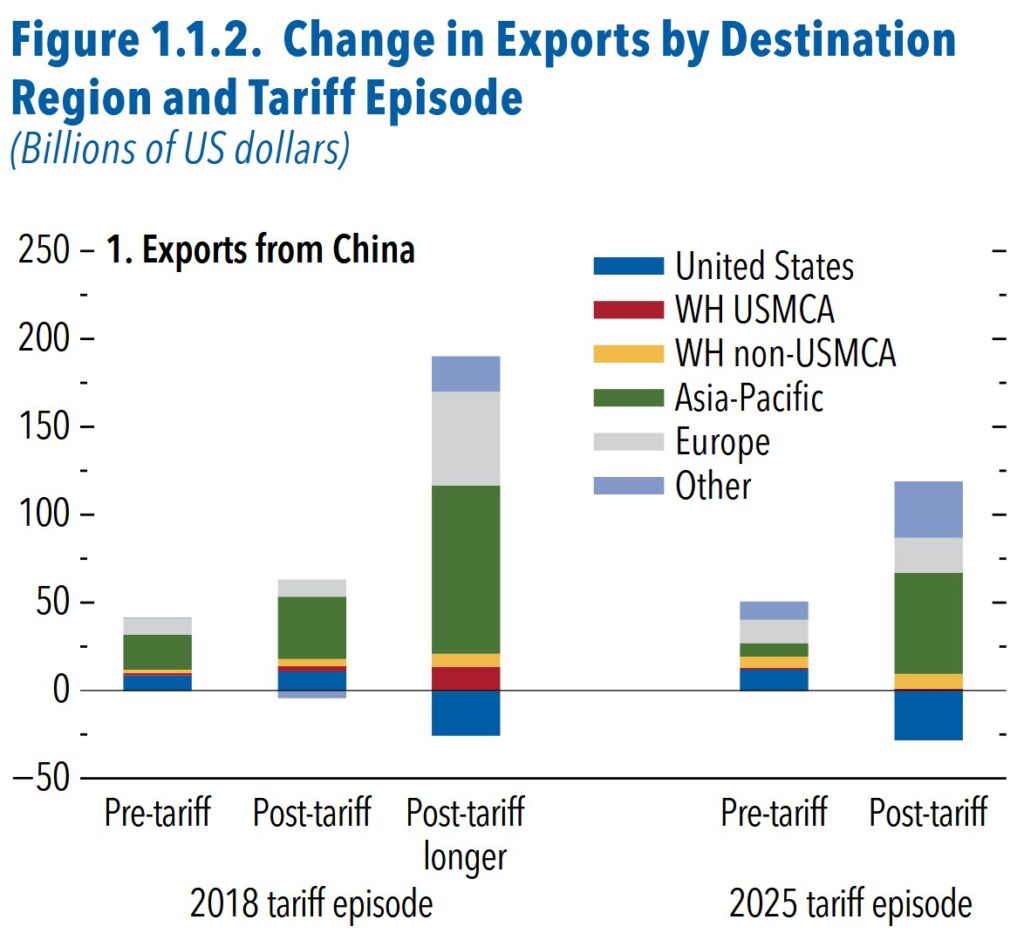
- The International Monetary Fund (IMF) released its biannual World Economic Outlook, which notes that the shock from the U.S. tariff surge remains moderate but inconclusive due to continued trade policy uncertainty, private sector agility, and technological drivers of growth.
- Regarding trade, the IMF compared the U.S.-China trade wars of 2025 and 2018 and observed faster trade reallocation from China to third markets this year. Notably, Canada and Mexico have accounted for a small share of China’s change in exports since Feb. 2025.
- The report also highlights a global resurgence of industrial policy interventions from governments attempting to address a host of priorities including clean technology, energy, and strategic manufacturing. The IMF assessed Chinese industrial policy as producing success in some technologies but lowering overall productivity.
Trade Remedies
TRUMP THREATENS BAN ON COOKING OIL FROM CHINA
- President Donald Trump is considering banning U.S. imports of used cooking oil (UCO) from China in retaliation for China’s steep drop in purchases of U.S. soybeans.
- Chinese UCO exports to the United States have already declined 65% this year following U.S tariffs and reductions in China’s export rebates.
- USDA reported in March that China’s exports of UCO peaked in 2024. However, after China eliminated the 13% export tax rebate for UCO, exports dropped by 60% month over month.
- The escalating tensions could lead to the cancellation of a planned meeting between Trump and Chinese President Xi Jinping during an upcoming trip to South Korea. American Soybean Association President (ASA) Caleb Ragland said ASA was “extremely disappointed that the planned meeting … is canceled as of right now.” ASA hoped for discussions to restore U.S. soybean exports.
Transportation
CHINA RETALIATES OVER U.S. PORT FEES ON CHINESE SHIPS
- China’s Ministry of Transport announced special fees at Chinese ports for vessels owned, operated, built, or flagged by U.S. entities effective Oct. 14, 2025. The move is in direct retaliation against U.S. port fees on Chinese-linked ships.
- The fees will be charged for up to five voyages per vessel per year, increasing gradually each year until they reach 1,120 yuan (about US$157) per net ton by 2028.
- The U.S. has instituted port fees on Chinese vessels as of Oct. 14 following the result of the Section 301 investigation. See the USTR proposed modifications for details on the latest changes.
PROGRESS DELAYED ON MARINE ENVIRONMENT PROTECTION COMMITTEE NET-ZERO FRAMEWORK
- On Oct. 17, the International Maritime Organization (IMO) adjourned its efforts to cut all large ships’ emissions by 17% before 2028 and will resume discussions in 2026.
- Delaine McCullough, shipping program director at Ocean Conservancy, calls the failure to come to an agreement “a major setback for people and the planet.”
- Global leaders such as the U.S., Saudi Arabia, and Russia all voiced concerns regarding the proposed regulation.
- In a post on X, Secretary of State Marco Rubio called the delay a “HUGE win” that “prevented a massive UN tax hike on American consumers.”