TRADE UPDATE
Food & Agriculture
December 9, 2025
By Kristy Goodfellow, Vice President of Trade and Industry Affairs, Ameya Khanapurkar, Project and Policy Coordinator, and Jacob Slattery, CRA Intern
HIGHLIGHTS
- US Farm Payments:
- In a meeting with U.S. farmers, President Donald Trump announced $12 billion in payments to farmers to compensate for low crop prices and tariff retaliation.
- Tariffs:
- Dozens of importers, including Costco, have filed protective lawsuits in the U.S. Court of International Trade (CIT) to preserve potential refund rights related to the tariffs at issue in the Supreme Court case. That case, which was argued in November, is challenging the duties that have been a key aspect of the Trump Administration’s trade policy.
- USMCA:
- Multiple agricultural groups testified at the U.S. Trade Representative hearings on the upcoming 2026 USMCA review. Most food and agriculture groups advocated for preservation and extension of the agreement, while a few groups advocated for changes.
- Supply Chains:
- Trump recently announced the creation of Food Supply Chain Security Task Forces to investigate anti-competitive practices and foreign control in U.S. food industries.
- US-Mexico:
- The Food and Drug Administration has granted conditional approval to a topical solution for the prevention and treatment of New World Screwworm infestations in cattle, as USDA confirmed detections 120 miles away from the U.S.-Mexico border.
- Trade Data:
- The November Ag Economy Barometer from Purdue University and the CME Group shows farmer sentiment jumped 10 points in November to 139 (the highest reading since June), driven largely by a sharp surge in optimism about the future.
“I mean [withdrawal from USMCA is] always a scenario, right? The president’s view is he only wants deals that are a good deal. The reason why we built a review period into USMCA was in case we needed to revise it, review it, or exit it. I have heard from a lot of folks how important USMCA is. Canada and Mexico are huge export markets for us.”
—U.S. Trade Representative Jamieson Greer, via Politico
US Farm Payments
WHITE HOUSE ANNOUNCES NEW TRADE-RELATED SUBSIDIES
- In a meeting with U.S. farmers, President Donald Trump announced $12 billion in payments to farmers to compensate for low crop prices and tariff retaliation.
- The program, dubbed the Farmer Bridge Assistance program, will be administered by USDA. The “bridge,” in this case, refers to a gap in time before additional assistance will be provided through payments under the Agriculture Risk Coverage and Price Loss Coverage programs and increased funding in the One Big Beautiful Bill Act.
- Farmers were compensated during the first Trump Administration for $23 billion in losses caused by international trade disruptions through the Market Facilitation Program (MFP). That program distributed funds in 2018 and 2019.
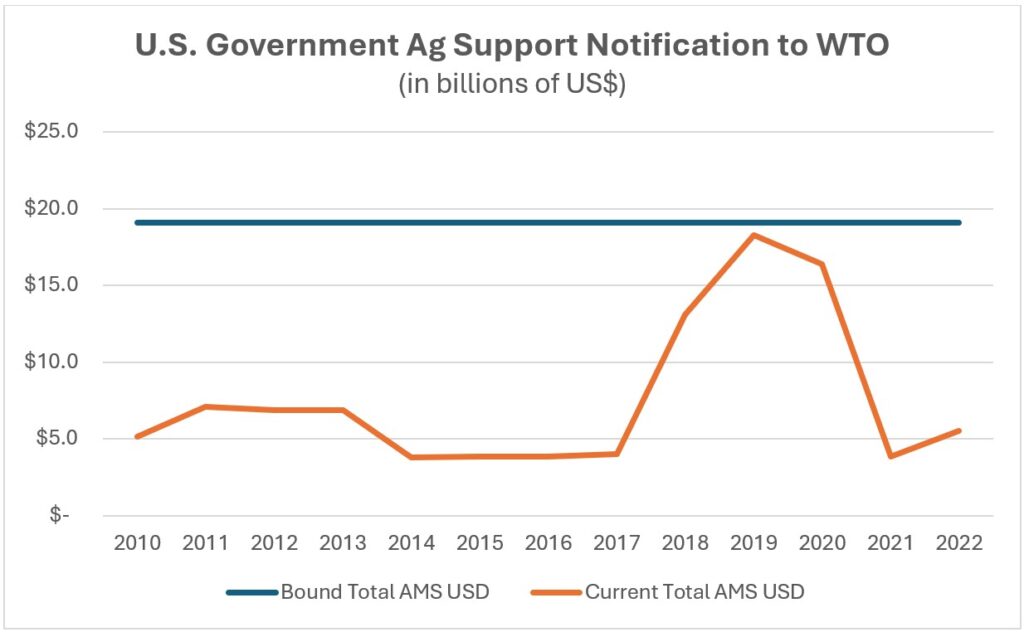
- Funding for MFP is not included in the Current Total Aggregate Measure of Support (AMS) — the total value of payments that are subject to the $19.1 billion annual World Trade Organization (WTO) limit for the United States — because of how they were administered by USDA and notified to the WTO.
Tariffs
TARIFF REFUND
- Dozens of importers have filed protective lawsuits in the U.S. Court of International Trade (CIT) to preserve potential refund rights related to the tariffs at issue in the Supreme Court case challenging the Trump Administration’s International Emergency Economic Powers Act (IEEPA) tariffs. According to an analysis from Holland & Knight, “these lawsuits protect an importer’s right to refunds of those tariffs if the Supreme Court determines that they should be returned.”
- Retail giant Costco filed its tariff refund lawsuit on Nov. 28.
- Costco seeks a declaration that the IEEPA duties are unlawful; an injunction preventing continued collection of IEEPA tariffs; a full refund on IEEPA tariffs, and an injunction to suspend impending liquidations.
- Costco’s complaint emphasizes that the entries in which Costco paid IEEPA duties are scheduled to begin liquidating in December. The case further notes that once entries are liquidated, importers may lose the right to recover refunds of duties paid, even if a tariff is later found to be unlawful.
- In November, the U.S. Supreme Court heard oral arguments regarding the legality of Trump’s tariff measures under IEEPA.
USMCA
USTR HEARINGS ON USMCA REVIEW
- Multiple agricultural groups testified this week at the U.S. Trade Representative hearings on the upcoming United States-Mexico-Canada Agreement (USMCA) review scheduled to take place in 2026.
- Most food and agricultural groups advocated for preservation and extension of the agreement, while a few groups advocated for changes such as restoring mandatory country of origin labeling and adding tariff-rate quotas for seasonal and perishable products.
- Groups, including the National Corn Growers Association and American Soybean Association, touted market stability and importance for their sectors’ competitiveness.
- Other organizations, such as the California Avocado Commission and the Florida Fruit and Vegetable Growers, warned of declining pest inspection standards and low-priced imports.
- Farm Action called for mandatory country-of-origin-labeling to help support the U.S. cattle industry.
- The National Milk Producers Federation, U.S. Dairy Export Council, and International Dairy Foods Association called on the Administration to address “implementation problems” or “violations.”
Supply Chains
ANTITRUST INVESTIGATION IN THE FOOD SUPPLY CHAIN
- Trump signed an executive order (EO) over the weekend ordering the creation of federal task forces to explore anti-competitive practices in the American food supply.
- The order noted price fixing and anticompetitive practices, “especially by foreign-controlled companies, threaten the stability and affordability of America’s food supply.” The EO’s background emphasized that the meat processing, seed, fertilizer, and equipment sectors are vulnerable to these practices.
- Under the EO, the Department of Justice (DOJ) and Federal Trade Commission (FTC) will both create Food Supply Chain Security Task Forces to investigate anti-competitive practices and foreign control in U.S. food industries, assessing impacts on prices and national security. Both task forces are to offer presentations to congressional leaders twice over the next year, including “any recommended congressional actions.”
- In November, the administration directed the DOJ to investigate meatpacking companies for collusion and price manipulation.
US-Mexico
TREATMENT APPROVED AS NEW DETECTIONS ANNOUNCED
- The U.S. Food and Drug Administration (FDA) has announced conditional approval for a topical solution for the prevention and treatment of New World Screwworm (NWS) infestations in cattle, including a 21-day protection against reinfestation.
- The FDA also conditionally approved an injectable solution in September.
- USDA recently confirmed detections at Nuevo León, about 120 miles away from the U.S.-Mexico border.
- NWS in Mexico and Central America has been an issue contributing to higher cattle prices and was discussed during the latest USDA trade mission to Mexico City.
Trade Data
FARMER SENTIMENT IN NOVEMBER
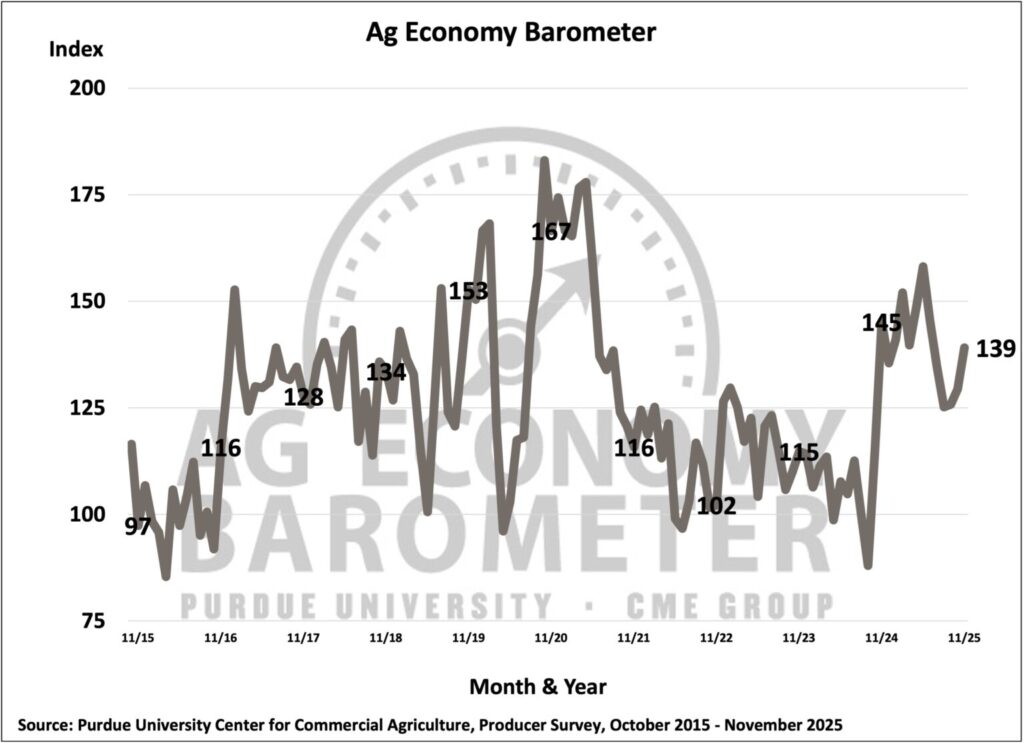
- The November Ag Economy Barometer from Purdue University and the CME Group shows farmer sentiment jumped 10 points in November to 139 (the highest reading since June), driven largely by a sharp surge in optimism about the future.
- The Future Expectations Index soared 15 points to 144, reflecting rising confidence in crop prices, export demand, and the broader trade outlook; by contrast, the Current Conditions Index fell slightly to 128, signaling cautious views of near-term farm conditions.
- Alongside improved expectations, other subindices reflected mixed farmer sentiment; the Farm Financial Performance Index rose to 92, but the Farm Capital Investment Index fell slightly, suggesting producers remain cautious about making major investments despite brighter short-term prospects.
- The November barometer also found producer financial optimism strengthening, with the Farm Financial Performance Index climbing to 92, a 14-point increase driven by stronger crop prices and export prospects. However, optimism was not uniform: livestock producers reported rising concern as cattle prices declined over the past month.